
What Comes From Clouds
What Comes from Clouds
by Julian Kreimer, MFA Chair
In the second paragraph of Ethan Frome, Edith Wharton summarizes the protagonist’s college studies: “though they had not gone far enough to be of much practical use they had fed his fancy and made him aware of huge cloudy meanings behind the daily face of things.” An MFA degree is rarely accused of providing excessive practical use, but learning to interpret the complex meanings that lie beneath the surface is precisely what these ten students have achieved.
More importantly, they have learned to work creatively within this cloudy, inchoate space through their tight-knit community, trusting their instincts and ambitions without knowing where each project will land.
MFA Thesis Exhibition: What Comes From Clouds
-
What Comes From Clouds
-
What Comes From Clouds
-
What Comes From Clouds
-
What Comes From Clouds
-
What Comes From Clouds
-
What Comes From Clouds
-
What Comes From Clouds
-
What Comes From Clouds
-
What Comes From Clouds
-
What Comes From Clouds
-
What Comes From Clouds
-
What Comes From Clouds
-
What Comes From Clouds


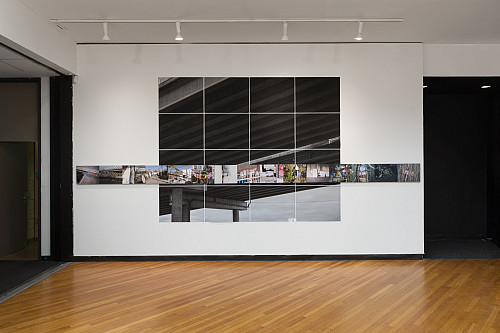
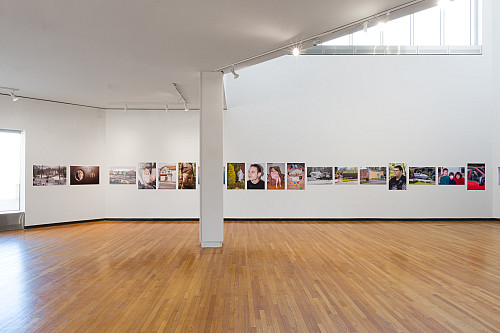
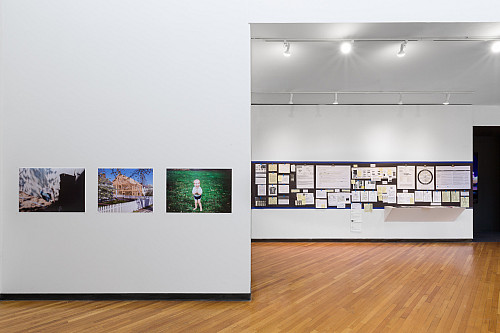
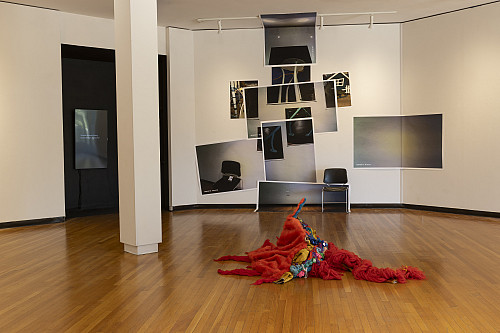
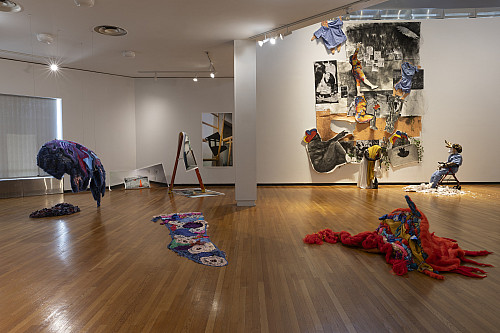
Chris Borgia’s photos document his frequent walks along the Queens section of Robert Moses’ Brooklyn-Queens Expressway. Small, colorful images of life occurring in the highway’s shadows punctuate huge black-and-white prints of massive infrastructure. Borgia has embraced playfulness as part of his artistic process: nailing prints right to the wall, pasting them like billboards out-of-doors, and transforming his photo exhibitions into low-relief installation.
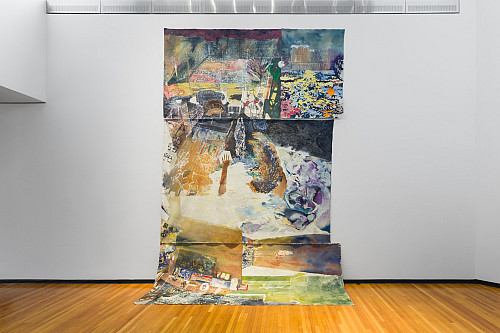
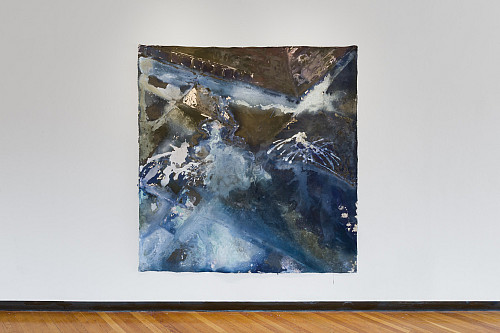
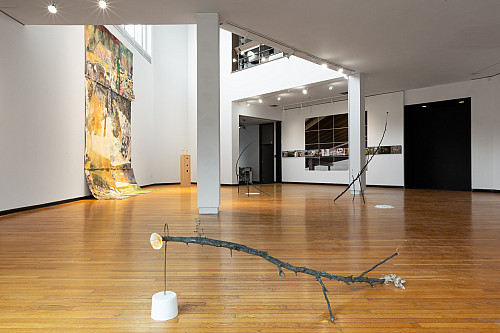
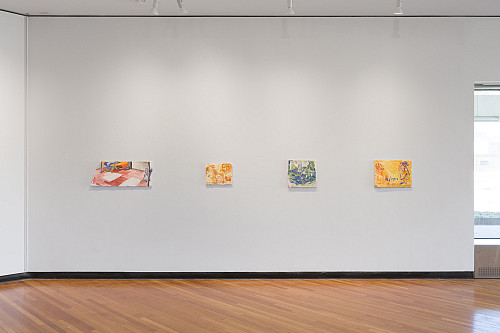
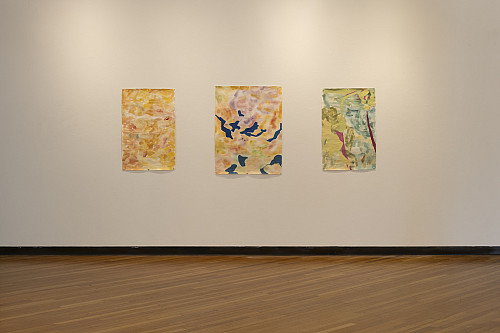
Tanisha D’souza wrestles buckets of paint onto enormous bolts of unstretched canvas on the ground. D’Souza began her MFA making small, figurative drawings of remembered and current lived-in spaces. Zany perspective folded an entire apartment into a single view, in others, an empty armchair recurred: a metonym of loss. As rooms led to windows led to gardens, D’Souza embraced a giant scale of canvases poured, rubbed onto, and wiped off, inventing an alphabet of processes in which marks paradoxically exist both abstractly and as evocations of personal stories.
Adrian Gray’s sculptural works seem to form part of a magical ceremony– found and made objects combine into assemblages charged with a sense of sacred devotion. Long, attenuated forms, like houses stretched tall, sprout branches from mud walls; while commodities like sugar and fruits appear as signifiers of the complicated history of production and trade in the Americas. These combinations seem tuned to the hallowed quiet of what Gray terms “veiled places.”
Nyssa Juneau’s prints, drawings, paintings and frescoes combine an obsessive reverence for techniques of the past with a confident hand that captures the vitality of life lived in community. Through sketching she embeds herself amongst chess devotees, subway riders, poker-players, flower sellers. These moments of quotidian virtue defy the authoritarian politics of the present, their jaunty lightness a confrontation to the shadowy present.
Bea Kaufman’s journey through the MFA program has seen her move from sculpture and puppet-making to a raucous neo-Burlesque performance practice that teases Jewish-American codes and characters. The conventions of burlesque—women seductively disrobing onstage—become confrontations that puncture the audience’s fixed ideas. In Burning Bush, Bea sets that eponymous bit of hair on fire, embodying the heretical pun in an act that, a Feminist update of the vanguard Yiddish vaudeville performers of the early 20th century.
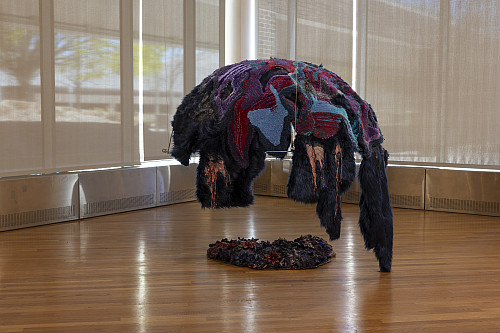
Raised Catholic in Italy, Gabriella Mazza has for years followed teachings that join Vedic and Christian spiritual traditions—an approach to the divine that finds form in her exuberantly colored works. Laboriously tufted tapestries nod to vernacular altars while depicting Goddesses reigning over transcendent realms. Spilling onto the floor like altars, her sculptures update the powerful mythos of the sacred feminine power of the universe.
Yuka Nakamura openness to new techniques at the start of her MFA combined with a clear-eyed focus on the transcendent moments of everyday parenthood. Being a Japanese artist living temporarily in the weird culture of suburban Westchester razor-sharpened her focus: McDonald’s fry containers, the made-up world of dress-up, the patterns of shadows cast by autumn leaves. Nakamura’s work distills temporal moments into abstract shapes and lines that revealing the fullness of the empty spaces between things.
Cnena Smith’s practice moves beyond boundaries. From colorful, affectionate pastel portraits of loved ones to her sculpture of two figures that is both eerie and tender, her work often spans mediums to convey a huge range of emotions. Works plumb the agonies of war and frightful symptoms of the apocalypse that Smith was raised to believe is impending, while making room for specific gestures of caring among her friends, family, and loved ones.
Christian Wilbur reclaims the literary tradition of suburban anomie in his hometown of Huntington, Long Island, a suburb designed for WWII veterans seeking domestic isolation as a balm after communal wartime living. Wilbur’s photos capture the post-pandemic souring of this geography of isolation, pointing to the absence of connection. Figures in forested gay cruising spots evoke a poignant sense of furtive desire, while penetrating portraits of family members present exhausted individuals stretched too thin.
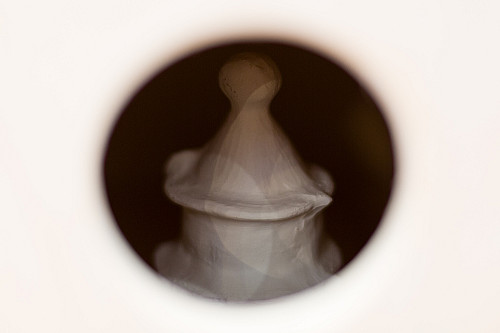
Animus Zhang’s works often present images of profound emptiness. Suppressing narrative, their mysterious photos present a world of spaces without people, highlighting both architecture as a space of projection and Animus’ own unique way of experiencing moments of pure perception stripped of emotions. In other works, they conjure a quiet sense of exile through juxtaposed ideograms, line drawings, and a windswept seascape.
Despite their varied mediums, two shared themes emerge. First: the need for connection, whether with people, animals, or a larger divine. Second, the close attention of immersion in a process, whether it’s capturing photos that reveal mental states, discovering shapes in the routines of family, coaxing embedded meanings from found objects or long-ago traditions. Both a necessity in this difficult context, a cloud from which we don’t know how we will emerge.
MFA Thesis Exhibition 1
March 4 - 18, 2026
Christopher Borgia, Tanisha D’souza, Adrian Gray
MFA Thesis Exhibition 2
April 8 - 17, 2026
Nyssa Juneau, Bea Kaufman, Christian Wilbur
MFA Thesis Exhibition 3
April 21 - 30, 2026
Gabriella Mazza, Yuka Nakamura, Nena Smith, Animus Zhang
MFA Thesis Exhibition, PS122
May 7 - 18, 2026
Reception: May 7, 5 pm
PS122 Gallery
150 1st Ave, New York, NY 10009