More Than Words: The Opportunity and Community of Purchase Publications
By Jamie Kenney ’05
When you talk about student life at Purchase, one idea never fails to come up: DIY.
The Do-It-Yourself ethos is both a reflection of the “creative types” drawn to the college’s brick-filled campus in the first place, and a testament to their ability to not only seize opportunities, but to make them. From concerts at The Stood to impromptu art shows in the woods, student productions in the Humanities Theatre to drag performances in The Olde, one of the college’s core identities is creating art that builds community. This has always included student publications, which continue to be an important part of that culture.
There are currently three main student-run publications at Purchase: The Purchase Phoenix, The Beat, and Italics Mine. Proof spoke with the editors and academic advisors of these three institutions to discuss how they reflect—and what they contribute to—life on campus.
The (Purchase) Phoenix Rising
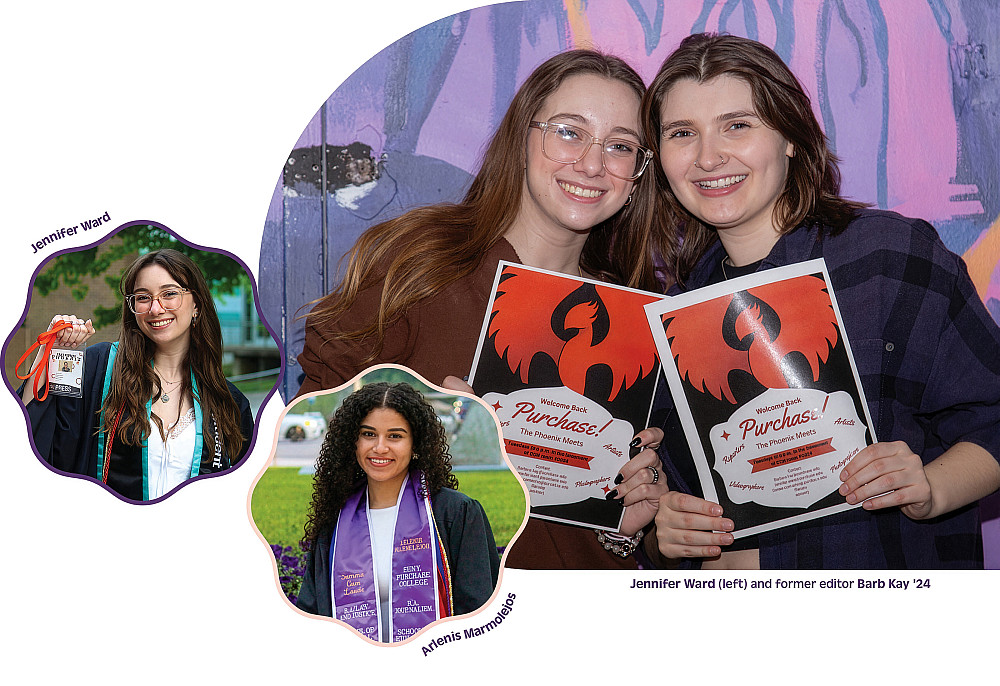
In some ways, weekly meetings for The Purchase Phoenix (formerly The Load and The Brick before a rebrand about 10 years ago) are exactly what you’d expect. Students gather to discuss what’s happening within the Purchase community—student government decisions, social events, protests, performances—and how best to share that news. But while the room is full of editors, interns, and contributors who do it “for the glory of the byline,” some people just come for the vibes, apparently.
“We have students who have shown up for years who never take on a story,” marvels Donna Cornachio, the publication’s faculty advisor for more than 10 years.
While she’d like to credit the homemade brownies she brings to every meeting for encouraging this inviting atmosphere, Cornachio says it’s thanks to the efforts of Editor-In-Chief Jennifer Ward ’25 (Journalism) and Managing Editor Arlenis Marmolejos ’25 (Journalism and Law and Justice Studies).
“We’ve definitely tried our best,” says Ward, who notes that even those who don’t contribute bylines are important to the paper’s success. “They might know somebody who can help with an article, or they’ll have a source. It’s just really such a nice little community.”
“We’ve really tried to create that as a foundation: to be accepting and welcoming to all students, especially if journalism is not your major,” Marmolejos says.
“Purchase is a very unique and artistic campus. There are different ways of expressing the news, so we’ve been trying to hone in on multimedia.”
And while both say they’ve become more deeply involved in student life as a result of this work (“Creating my own opportunities within the campus started with The Phoenix,” Marmolejos observes), The Phoenix remains their favorite claim to fame. “People hear my name,” says Ward cheerfully, “and they just know, ‘Oh, you’re the girl from The Phoenix !’” And there’s always a little bit of pride: “‘Yeah! I’m the girl from The Phoenix !’ And then sometimes they pull me aside and whisper, ‘I have something I need to tell you …’”

The Beat Goes On
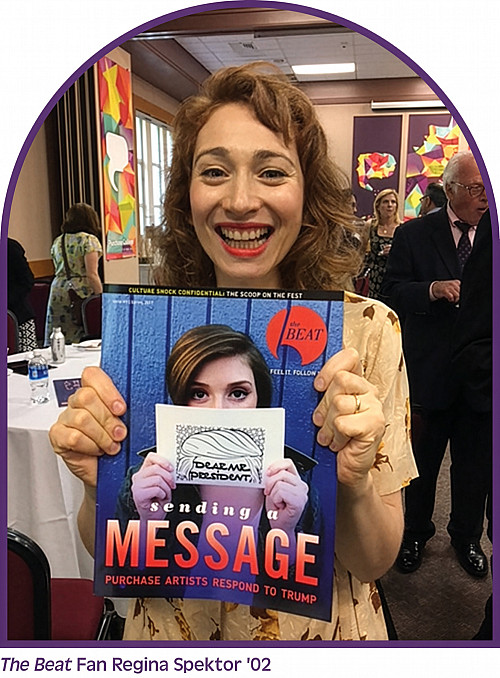
The Beat , Purchase’s arts journalism publication, was first conceived in 2011 by faculty advisor Andrew Salomon and his students. The inaugural issue launched in fall 2012 through a successful Kickstarter campaign and, in his words, “sweat equity.”
“That’s all a credit to the students and their drive and their belief,” he tells Proof. “And I think that’s the most Purchase thing … [students] are used to that DIY aesthetic and The Beat has been DIY since its very beginnings.”
Approximately 10 to 20 students take Salomon’s course—The Beat : Magazine Production—to produce digital content in the fall semester. Spring is dedicated to publishing a print edition. Last spring, The Beat ’s Editor-In-Chief was Sophia Castro-Astor ’25 (Journalism). After years of working on the publication, she had a bold and ambitious idea for her final issue: to redesign the magazine as part of her senior project.
“I just kind of felt like we could make it look a little bit more Purchase-y,” she says. To Castro-Astor, this meant putting more emphasis on the visual component while maintaining high-quality writing. The result is a gorgeously produced exploration of the arts on campus, full of stunning photographs, interviews, reviews, profiles, and more. For Castro-Astor, it’s in many ways a culmination of her four years of college experience.
“[The Beat ] has been a huge part of my college life,” she says, explaining that writing for the publication introduced her to shows, events, and people she may not have known about otherwise. “It taught me how to write better and edit better. And this year especially, it’s taught me a lot about leadership.”
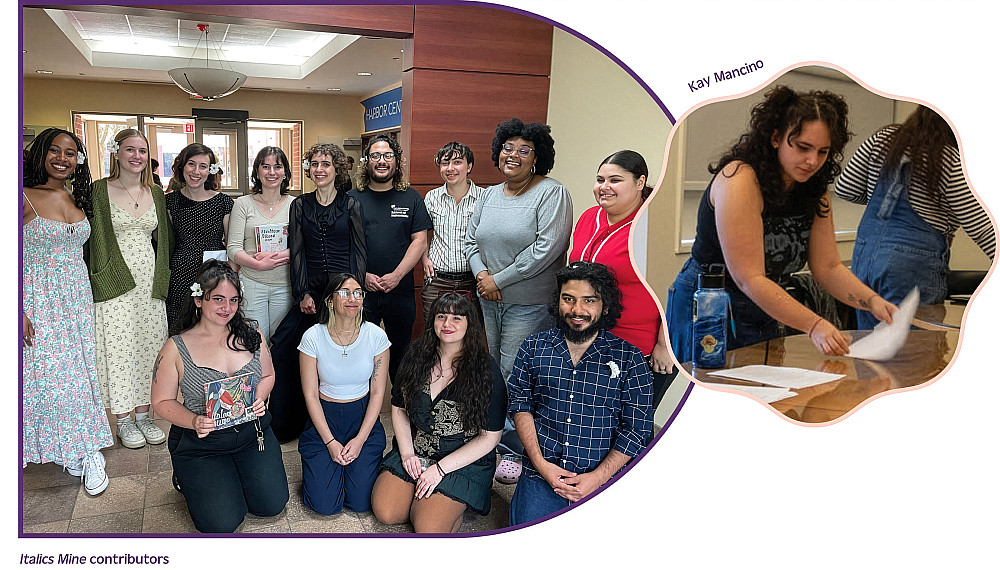
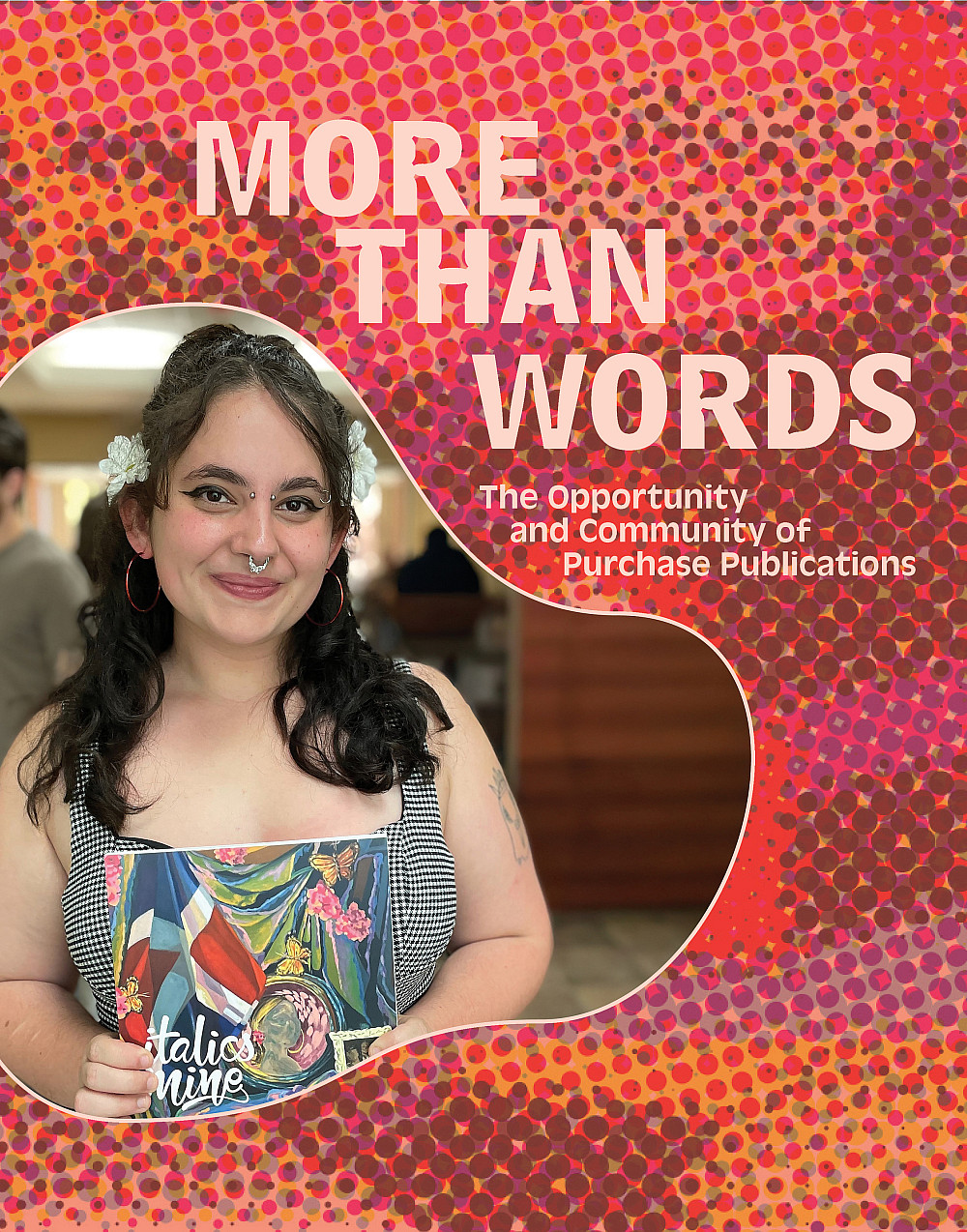
Italics Mine—Purchase and Beyond
The school’s literary magazine, which primarily features fiction and poetry, has been a Purchase institution for more than 20 years. Rooted in two creative writing courses, Editing and Production Workshop, the fall semester focuses on editing, and the spring on producing the magazine. Submissions are open to anyone on campus and beyond.

“We have so many different editors with different visions and voices,” she notes. “And they work extremely well together, but there were times when … [faculty advisor] Lee Conell and I had to really make sure that our students were on the same page. None of them were combative at all, and they were very respectful, but gathering together 11 writers and creatives who all have different visions can sometimes be a challenge.”
“When the students started in the fall, I think they were nervous about taking on pieces to edit and doing justice to them,” says Assistant Professor of Creative Writing Lee Conell, fresh off her first year of advising for Italics Mine.
“I felt like the class really came together in an amazing way. Once they were talking about pieces, I could really see their excitement … it was so cool to see their confidence and sense of community growing.”
After their joint interview with Proof, Mancino and Conell said they’re going to discuss the future of Italics Mine —and decide which editors showed over the course of this year that they have what it takes to lead the
charge in 2025–2026.
The Next Generation
All the editors and advisors who spoke to Proof are mindful, melancholy, and excited about handing the reins over to next year’s teams as they move on to their post-Purchase lives.
“I am being so careful,” Ward says, in reviewing applications for The Phoenix editor-in-chief position, “because this is my baby.”
Castro-Astor says she already has an idea of who will be taking over at The Beat. “I’m excited to see what she does. And I hope they just continue making it their Purchase in a magazine.”
Do Purchase students know any other way?