
What Is Photography?
How Do You Define Photography?
For professors Joshua Lutz and Katie Murray, the answer was clear—let the students decide.
The colleagues co-created the Photography Is… festival as an open-ended framework “rooted in a pedagogical commitment to let students define photography for themselves rather than have a definition imposed upon them,” explains Lutz, Associate Professor of Photography and Chair of the department. Murray is an Assistant Professor of Photography. The festival took place from September 18 to November 22, 2024, featuring over 25 public programs, including exhibitions, lectures, workshops, screenings, and student-led installations.
“What made it unique was the intentional placement of student voices directly alongside internationally recognized artists and alumni, creating real dialogue rather than a top-down showcase,” says Lutz.
Major events drew up to 150 attendees, with crowds packing some exhibitions wall-to-wall. Alumni flew in to attend, and visiting artists from as far as Belgium and London led talks and informal gatherings.
Exhibition highlights included Photography Is… in the Visual Arts Building’s Maass Gallery. Featuring work by a dozen artists, including Marina Berio, James Casebere, Lois Conner, Gregory Eddi Jones, Justine Kurland, Andrea Modica, Nandita Raman, and David Wojnarowicz, and more, the exhibition showcased photographic practices, from early Daguerreotypes to contemporary uses of artificial intelligence, while demonstrating both the revealing and concealing power of images.
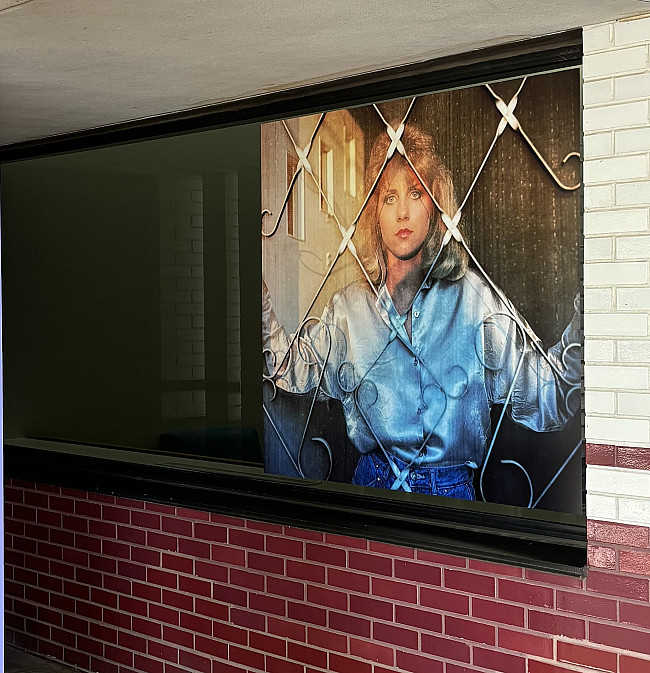
And Photography is Us celebrated 50 years of faculty and alumni contributions, demonstrating the evolution of photographic practice at Purchase through the work of 28 artists, including Nicholas Bruno ’15, Veronica Cruz ’22, Regina De Luise ’81, Bob Kozma, Zoeann Murphy ’03, Justin O’Neill ’94, Leonard Stokes, and Jo Ann Walters, among many more.
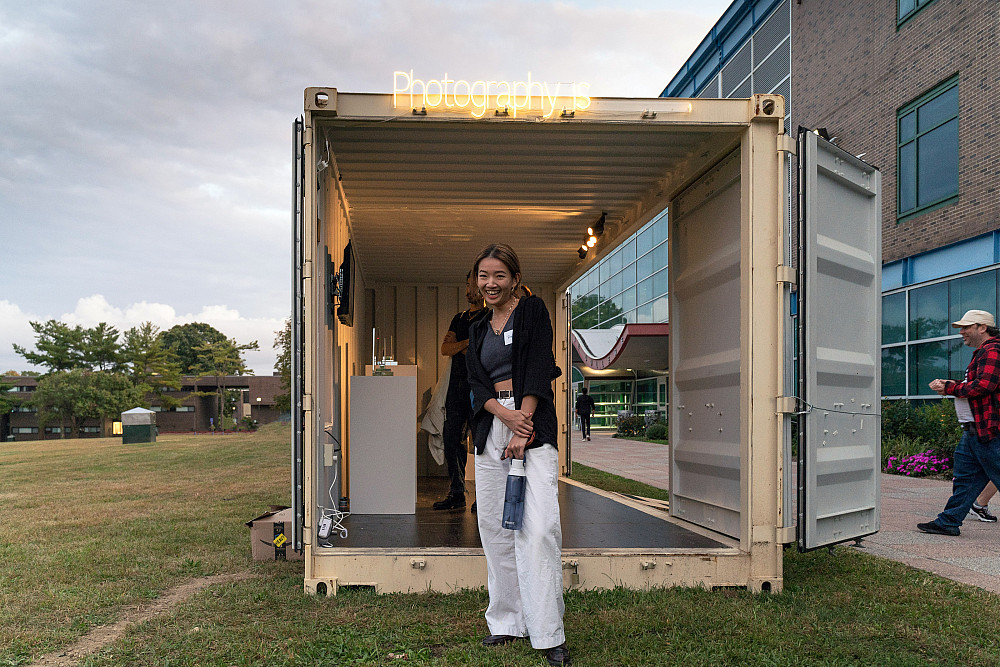
Even casual viewers could engage with work placed in highly visible locations—such as windows in Campus Center North, the Natural and Social Sciences Buildings, the Multicultural Center, and the Student Services Building. A metal shipping container, doubling as an experimental space for students, stood on the Great Lawn. For ten weeks, students transformed it into a weekly series of exhibitions, performances, or installations, rendering it “…both a physical structure and a conceptual framework: a vessel for ideas, a stage for image-making, and a space to question how photographs occupy and shape the world around them,” according to the forthcoming Photography Is… catalog (Conveyor Studio, 2025).
“One of the most meaningful outcomes was seeing students realize that their work—often deeply personal, experimental, or politically urgent—could hold space next to the work of photographers like David Wojnarowicz, Justine Kurland, and Andrea Modica. The feedback we received centered not just on inspiration, but on transformation.”
Lutz, who admits it was “by far the most ambitious programmatic initiative I’ve undertaken,” hopes to make it a recurring tradition every four years.